
DJI AP100 Parachute — Flight Termination Parachute System for Matrice 400
DJI AP100 Parachute
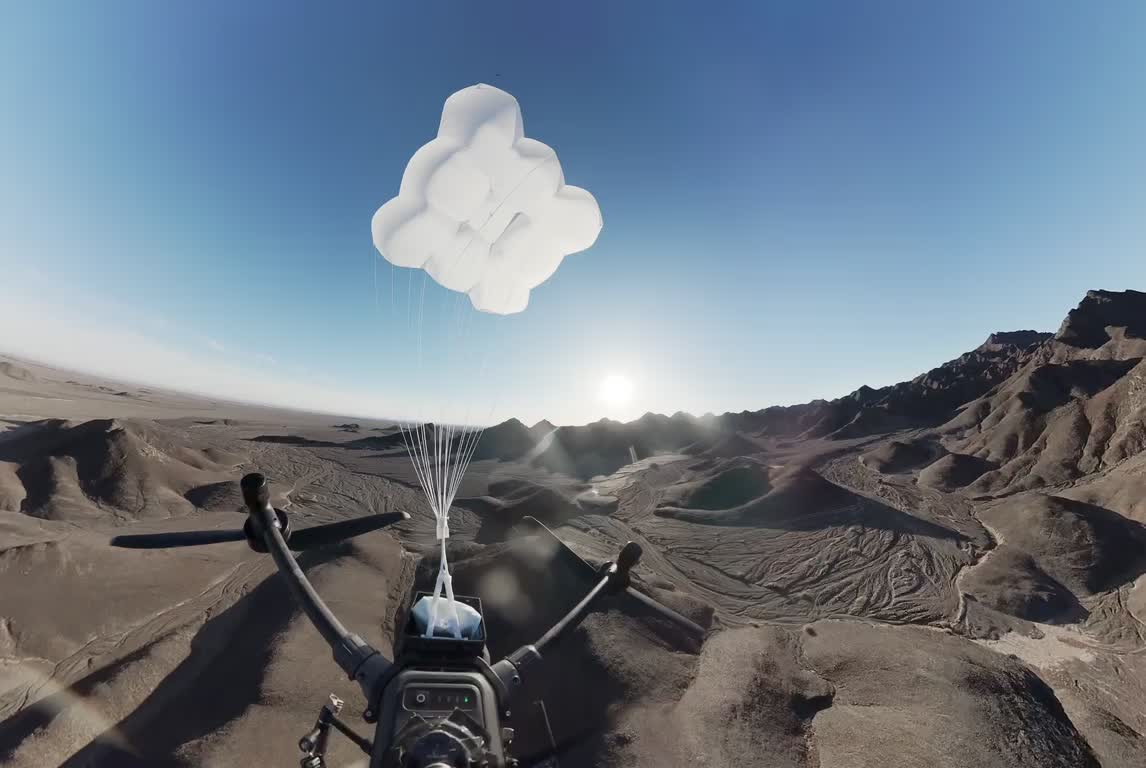
Built for the priceless below, DJI AP100 Parachute enables Matrice 400 to conduct C5/UK5 and C6/UK6 operations. With independent power and full-link redundancy, it supports both manual and automatic deployment; a response time under 600 ms and a descent rate below 5 m/s help protect your platform, payloads, and the ground below.
DJIAP100Parachute
DJI AP100 Parachute is an independently powered, full-link redundant flight termination system built for Matrice 400. Supporting both manual and automatic deployment, it features a response time under 600 ms and a descent rate below 5 m/s to help protect your platform, payloads, and the ground below. When mounted on Matrice 400, the system helps meet the European Union Aviation Safety Agency's (EASA) C5/C6 and the UK Civil Aviation Authority's (CAA) UK5/UK6 operational safety requirements, facilitating compliance for Standard Scenarios covering flights over populated urban areas (STS-01) and Beyond Visual Line of Sight (BVLOS) operations (STS-02).
Key Specifications
Overview
Watch the overview video covering DJI AP100 Parachute's deployment scenarios and EASA/CAA compliance.
European Standards for Compliant Flights
EASA C5/C6 | CAA UK5/UK6 — When paired with DJI AP100 Parachute, Matrice 400 meets the European Union Aviation Safety Agency's (EASA) C5/C6 and the UK Civil Aviation Authority's (CAA) UK5/UK6 operational safety requirements. It facilitates compliance for Standard Scenarios, including flights over populated urban areas (STS-01) and Beyond Visual Line of Sight (BVLOS) operations (STS-02).
ContinuousSelf-Diagnostics
From the moment Matrice 400 powers on and throughout the entire flight, the parachute continuously monitors the status of the gas generator and communication links. If an anomaly occurs, real-time alerts are displayed via the Health Management System (HMS) in DJI Pilot 2, ensuring safe operation.
IntelligentAlgorithms,RedundancyValidation
Equipped with an independent flight control system and sensors like IMU, the parachute functions as a self-contained safety module. Intelligent algorithms continuously cross-validate data between the drone and the parachute in real time, significantly reducing the risk of accidental deployment.
IndependentPower
Built-in dual capacitors provide up to 1 hour of independent backup power. This helps ensure uninterrupted flight attitude monitoring and automatic deployment, without relying on main aircraft power or an active E-Port connection.
InstantMotorCut-Off
When triggered, an independent Flight Termination System (FTS) cuts motor power within 600 ms, stopping the rotors before parachute ejection to prevent entanglement.
AudioandVisualAlarms
After deployment, the system continuously emits loud alarms and high-intensity flashing lights for approximately 1 hour. This warns people on the ground to clear the area and helps operators quickly locate and recover the equipment.
AutomaticDeployment
Automatically deploys when it detects flight attitude or speed anomalies. In the EU, UK, and other supported countries or regions, it also triggers when the drone breaches a Geocaging boundary set in DJI Pilot 2. Automatic deployment response time is under 600 ms, with a stabilized descent speed below 5 m/s at ≥30 m altitude.
ManualDeployment
Trigger deployment with the on-screen slider in DJI Pilot 2. In the EU, UK, and other supported countries or regions, remote deployment is also available through DJI FlightHub 2's Flight Termination System (FTS) page using the Aircraft SN and a verification code (DJI Cellular Dongle 2 and 4G required).
LightweightDesign,FitsDroneCase
Weighing approx. 935 g, the system preserves Matrice 400's 15.8 kg maximum takeoff weight, with a minimal flight time impact of about 6 minutes.
EasyStorage
The rear-mounted design avoids interference with battery swaps or payloads. Matrice 400 fits directly into its carrying case with the parachute attached, saving setup time in the field.
BuiltforHarshEnvironments
Sharing Matrice 400's IP55 rating, the system operates reliably in challenging conditions, including heavy dust or rain. It also maintains stable performance across temperatures from -20° to 50° C (-4° to 122° F), delivering consistent results in both hot and cold conditions.
Technical Specifications
| Feature | Value |
|---|---|
| Compatible Platform | DJI Matrice 400 |
| Weight | Approx. 935 g |
| Deployment Methods | Automatic (attitude/speed anomaly, Geocaging breach) and Manual (DJI Pilot 2 slider, DJI FlightHub 2 FTS page) |
| Automatic Deployment Response Time | Under 600 ms |
| Motor Cut-Off Time | Within 600 ms (FTS trigger to gas generator signal) |
| Stabilized Descent Rate | Below 5 m/s (at ≥30 m altitude) |
| Minimum Deployment Altitude | 30 m |
| Independent Backup Power | Up to 1 hour via dual capacitors |
| Alarm Duration | Approx. 1 hour of audio/visual alerts after deployment |
| Certifications | EASA C5/C6, CAA UK5/UK6 |
| Standard Scenario Compliance | STS-01 (VLOS, populated area) and STS-02 (BVLOS) |
| Protection Rating | IP55 (shared with Matrice 400) |
| Operating Temperature | -20° to 50° C (-4° to 122° F) |
| Mounting | Rear-mounted; fits directly into the carrying case while attached |
| Flight Time Impact | About 6 minutes (at 15.8 kg max takeoff weight) |
Use Cases
DJI AP100 Parachute, Backed by Bisavunma
As an official DJI Enterprise dealer, Bisavunma manages end-to-end installation, EASA/CAA compliance guidance, and technical support for DJI AP100 Parachute. Our team is ready for your technical specification, pricing, and site survey requests.
GetaQuote
Contact our team for detailed information and a tailored enterprise quote for DJI AP100 Parachute and our other solutions.