
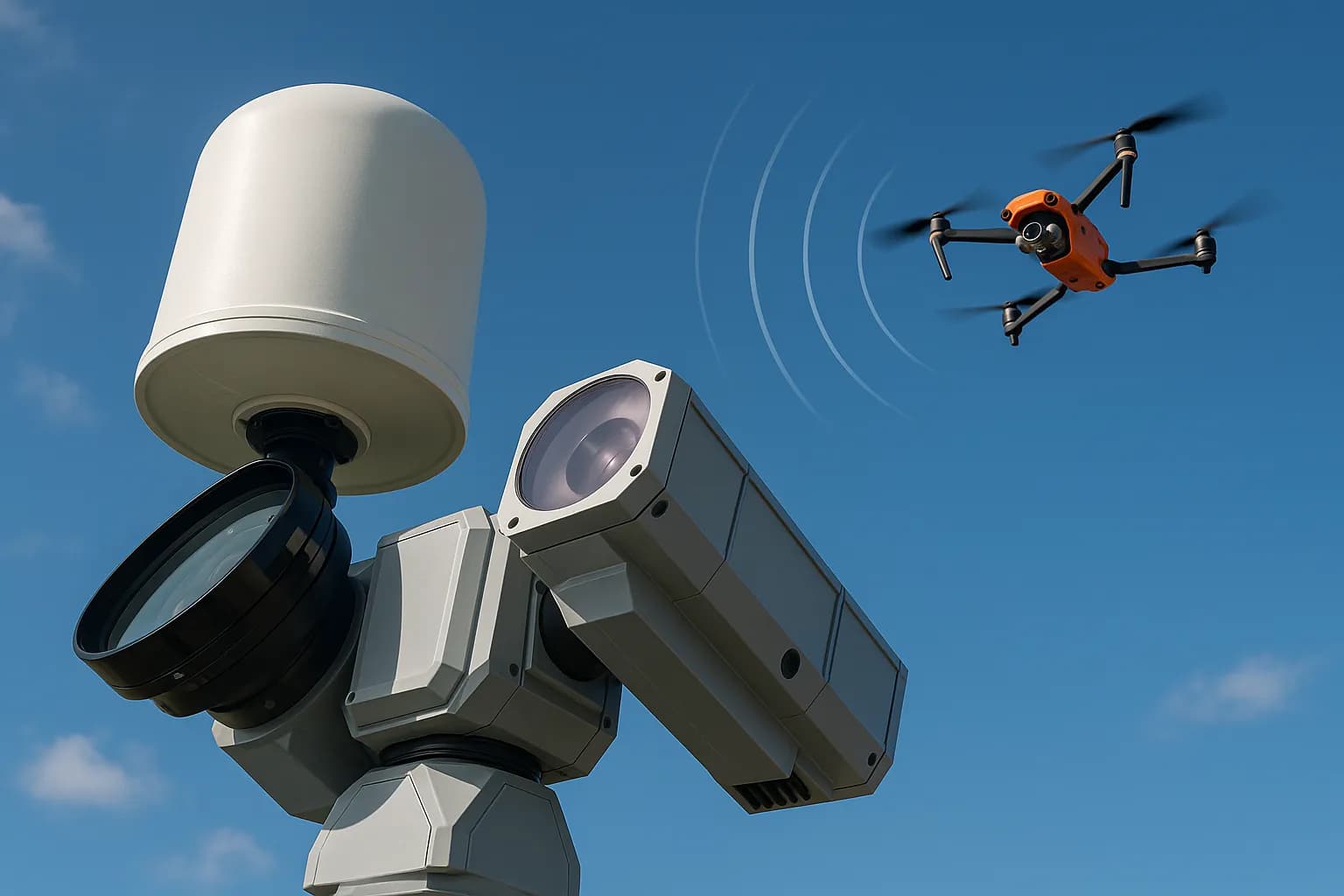
An unauthorized drone near a runway or terminal can halt flight operations; airports need a continuous, low-false-alarm detection layer to keep that from happening.
Airports are environments where dozens of takeoffs and landings occur every hour, coordinated on a timescale of seconds. In this setting, a drone detected near a runway doesn't need to pose an actual collision risk to trigger a precautionary halt to operations — and that alone carries serious economic and operational cost.
Radar-based detection around an airport has to operate in an environment dense with bird flocks, air traffic, and ground service vehicles. Airport C-UAS radars are therefore expected to run advanced classification algorithms capable of distinguishing small targets from this background clutter while keeping the false-alarm rate low.
Integration with Air Traffic Control
The value of an airport C-UAS system is measured not only by its detection capability but by how quickly and clearly that information reaches the air traffic control team. In an ideal architecture, a detected drone track is automatically relayed to the relevant tower, keeping pilots and controllers coordinated and informed.
Airport perimeters typically span a wide boundary and a complex layout, meaning a single radar station may not be able to cover every sensitive zone — runway thresholds, the terminal apron, approach corridors. This is why airport projects require a site survey that produces a radar/camera placement plan with no blind spots.

Let's Discuss a Radar Solution for Your Sector
Contact our team to select the right radar, sensor fusion, and response system for your facility's risk profile.
Get a Quote